





















Reviewed by Roxane Vogel, PhD
Your body only carries so much stored energy, and a marathon burns through it faster than you can replace it from breakfast alone.
A large-scale analysis of marathon race records found that a significant late-race slowdown, commonly called "hitting the wall," is a common outcome tied to depletion of the body's energy stores, particularly among runners chasing a personal best (Smyth, 2021).
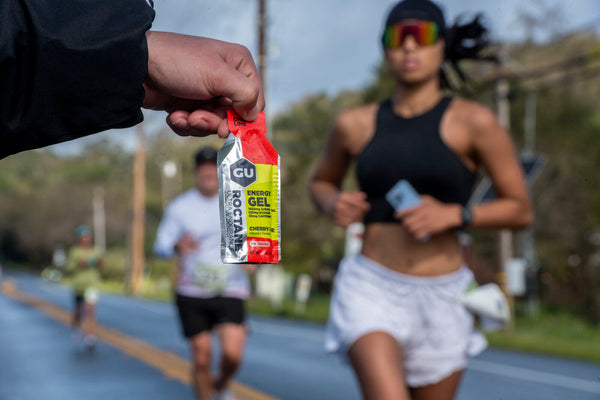
That's why what you eat during the race matters as much as your training. The real question isn't whether to fuel. It's how much, and how often. This guide gives you a simple formula to figure out what works best for you and your race.
The race-day math: most marathoners need 8 to 15 Original Energy Gels, spaced every 20 to 30 minutes depending on target carbohydrate rate. The tables below break down exactly how those numbers apply to your finish time.
New to marathon training altogether? Read this guide to building your base mileage and overall training structure. This guide picks up from there, once you're ready to dial in race-day fueling specifics.
How to Fuel for a Marathon: The Three Numbers That Matter
A solid marathon fueling strategy comes down to the same three numbers every time. Once you know these, the tables and formula below are just arithmetic.
- How long you'll be racing. Your expected finish time sets your total carbohydrate need. More time on course means more fuel to replace.
- Your target carbohydrate rate. Your target carbohydrate rate is measured in grams of carbohydrate per hour, or the pace you're taking in fuel. It's a guide for how much fuel your body generally needs relative to your effort.
- Carbohydrate per gel. GU Original Energy Gel provides 21g per packet, GU's stated minimum per serving. This is the unit that converts your target rate into an actual gel count.
Here's how those three variables play out for your fueling strategy.
Gel Count by Finish Time
|
Finish Time |
Gels at 50g/h* |
Gels at 75g/h* |
|
Sub-3:00 |
8 |
11 |
|
3:00-3:30 |
8 |
12 |
|
3:30-4:00 |
9 |
14 |
|
4:00-4:30 |
11 |
16 |
|
4:30-5:00 |
12 |
17 |
|
5:00+ |
12+ |
18+ |
*Both columns assume GU Original Energy Gels at 21g of carbohydrate per packet.
- 50g/h column: a gel roughly every 25 minutes. Good starting target if you haven't specifically gut-trained.
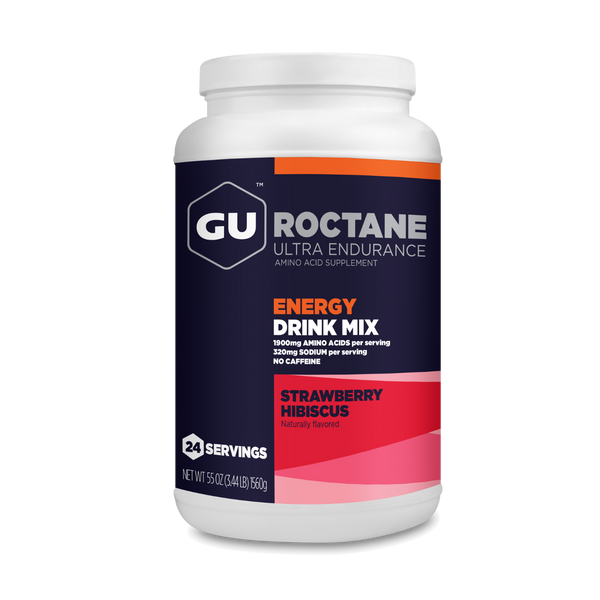
- 75g/h column: reaching this from gels alone would mean spacing tighter than GU's standard 20 to 30 minute guidance. Pairing a gel every 20 minutes with GU Roctane Energy Drink Mix between them is the practical way to hit this target. Reflects a gut-trained rate.
Athlete’s note: These totals assume gels as the sole carbohydrate source. Splitting intake between gels and GU Roctane Energy Drink Mix at aid stations lowers the gel count without lowering total carbohydrate intake.
The Gel Count Formula
|
DURATION (hr) |
X |
TARGET RATE (g/h) |
÷ |
CARBS PER GEL |
= GEL COUNT |
Multiply your race duration by your target rate, then divide by the carbs in one gel, that's your total gel count. Plug in your own numbers below.
For example: a runner targeting a 4-hour marathon at 50g/h needs roughly 2.4 gels per hour, or about 9 to 10 gels across the full race.
Which GU product fits the formula?
|
Product |
Carb per serving |
What it's built for |
|
21g |
The default choice for most training and racing |
|
|
21g, plus 2-3x the sodium and amino acids of Original |
Hot, long, or high-intensity efforts with heavier electrolyte loss |
|
|
24g, same amino acid profile as Original |
A thinner format for when a traditional gel feels too heavy, or late in a hot race |
|
|
~22g per serving |
A chewable rotation option to break up gel fatigue over a long race |
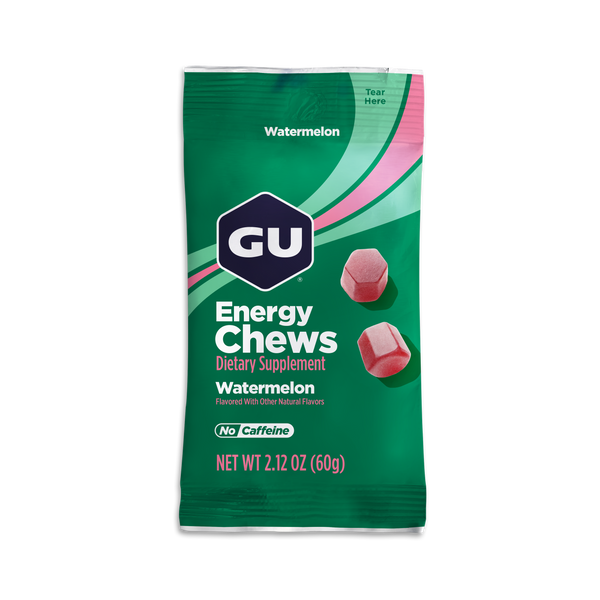
Because carb content per serving is similar across the GU lineup, you can swap Roctane in for a hot or demanding stretch, or rotate in Liquid Energy or Chews for variety, without needing to redo the math.
Gel Count by Race Goal
The Athlete Chasing a Sub-3:30
At this pace, gut demands are high and aid station windows are short. A gel every 20 to 25 minutes, practiced at goal pace in training, keeps intake steady without requiring a mid-race decision.
Roctane Energy Gel, with its higher electrolyte and amino acid content, is built for this intensity and effort duration.
The 4-Hour Marathoner
This is the widest band of the marathon field, and also where fueling plans are most often improvised rather than practiced. Nine to eleven Original Energy Gels, spaced every 23 to 28 minutes, covers a 45 to 60g/h target.
This is also the finish time range where switching formats partway through, from gel to Liquid Energy or Chews, can help manage flavor fatigue over four-plus hours on course.
The 5-Hour-Plus Marathoner
Longer time on course means more total fueling events and a higher cumulative GI demand.
Liquid Energy, which uses the same dual-source carbohydrate approach in a lower-viscosity format, is worth building into the back half of a plan like this, since heat and prolonged effort reduce blood flow to the gut, which slows gastric emptying and increases GI symptom risk (Costa et al., 2019).
|
Effort Duration |
First Gel |
Subsequent Gels |
|
Under 60 min |
5 min before start |
Not typically needed |
|
60-90 min |
5 min before start |
1 gel at 45-60 min |
|
90 min - 3 hr |
5 min before start |
Every 25-30 min after first |
|
3+ hr |
5 min before start |
Every 20-30 min throughout |
Always hydrate alongside your gels. Water supports absorption and helps offset the added GI demand of concentrated carbohydrate intake, making it easier on your gut.
Fueling a Hot Marathon
Heat adds a layer of GI demand on top of the carbohydrate load itself. As core temperature rises, blood flow is redirected toward the skin for cooling and away from the gut, which can slow gastric emptying and increase GI symptom risk (Sumi et al., 2023).
What to do: on hot race days, Liquid Energy or Chews, taken in smaller, more frequent doses than a full gel, can be easier to manage than the same total carbohydrate delivered all at once.
Half Marathon Gel Count
Half marathon finish times can run from about 1:15 at the elite level to over 3:00 for recreational finishers, which is a wider range, proportionally, than the marathon. The same 30 to 60g/h target applies, only scaled to a shorter duration.
|
Finish Time |
Gels (45-60g/h target) |
|
Sub-1:30 |
3-4 |
|
1:30-2:00 |
4-5 |
|
2:00-2:30 |
5-6 |
|
2:30+ |
6-7 |
Runners finishing under about 75 minutes may not need a full fueling protocol at all, since glycogen depletion is less of a limiting factor at that duration (Podlogar and Wallis, 2022). A single gel taken 5 to 10 minutes before the start can still support the effort without adding mid-race intake.
Training Your Gut to Handle More
GI issues mid-race are rarely random. They're typically the result of things like unfamiliar nutrition or taking in too much fuel too quickly.
The evidence: A systematic literature review of gut-training interventions found that repeated exposure to carbohydrate during training reduced gut discomfort by an average of 47% and cut carbohydrate malabsorption by 45 to 54%, after just a two-week structured protocol (Martinez et al., 2023).
The takeaway: The intestine adapts to the demand placed on it, provided that demand is introduced gradually and practiced consistently, not attempted for the first time on race day.
The Evidence Behind the Rate Ranges
- 30-60g/h: the baseline range most runners can absorb from a single carbohydrate source without training for more
- 60-90g/h: achievable when the source combines glucose (or maltodextrin) and fructose, since the two sugars use separate intestinal transport pathways and don't compete for absorption at the same site (Arjomandkhah et al., 2025)
- 90g/h+: reserved for well-trained guts; a study of elite runners during a mountain marathon found that 120g/h reduced markers of exercise-induced muscle damage compared to both 90g/h and 60g/h (Viribay et al., 2020), though reaching this without GI distress requires the structured gut training described above
What the broader research shows: A systematic review and meta-analysis of carbohydrate feeding during endurance exercise found consistent performance benefits from acute carbohydrate intake, supporting fueling during the race itself over relying on pre-race glycogen alone (Ramos-Campo et al., 2023).
What real-world runners actually do: In a study of 160 runners at the 2022 Seville Marathon, those who hit the 60-90g/h target were significantly more likely to finish in under three hours. The catch: the study's median runner intake fell well short of that target (Jiménez-Alfageme et al., 2025). Most runners are under fueling relative to what the research supports, which is the gap this guide is built to close.
In practice: test your planned race-day gel interval and count on long training runs, at goal pace, well before race week. The athletes who get this right aren't the ones with the highest pain tolerance. They're the ones who trained their gut, timed their fuel, and matched their format to the demands of the day.
References
- Martinez, I.G., Mika, A.S., Biesiekierski, J.R., and Costa, R.J.S. The Effect of Gut-Training and Feeding-Challenge on Markers of Gastrointestinal Status in Response to Endurance Exercise: A Systematic Literature Review. Sports Medicine, 2023. 53(6): p. 1175-1200. https://pmc.ncbi.nlm.nih.gov/articles/PMC10185635/
- Arjomandkhah, N.C., King, A.J., Griffiths, A., King, R.F.G.J., Morrison, D.J., Preston, T., and O'Hara, J.P. Glucose and fructose contributions to exogenous carbohydrate oxidation and performance at moderate altitude. Journal of Physiology, 2025. PMID: 42166208. https://pubmed.ncbi.nlm.nih.gov/42166208/
- Costa, R.J.S., Gaskell, S.K., McCubbin, A.J., and Snipe, R.M.J. Exertional-heat stress-associated gastrointestinal perturbations during Olympic sports: Management strategies for athletes preparing and competing in the 2020 Tokyo Olympic Games. Temperature, 2019. 7(1): p. 58-88. https://pmc.ncbi.nlm.nih.gov/articles/PMC7053925/
- Podlogar, T. and Wallis, G.A. New Horizons in Carbohydrate Research and Application for Endurance Athletes. Sports Medicine, 2022. 52(Suppl 1): p. 5-23. https://doi.org/10.1007/s40279-022-01757-1
- Ramos-Campo, D.J., Clemente-Suárez, V.J., Cupeiro, R., et al. The ergogenic effects of acute carbohydrate feeding on endurance performance: a systematic review, meta-analysis and meta-regression. Critical Reviews in Food Science and Nutrition, 2024. 64(30): p. 11196-11205. https://doi.org/10.1080/10408398.2023.2233633
- Smyth, B. How recreational marathon runners hit the wall: A large-scale data analysis of late-race pacing collapse in the marathon. PLoS ONE, 2021. 16(5): e0251513. https://doi.org/10.1371/journal.pone.0251513
- Sumi, D., Nagatsuka, H., Matsuo, K., Okazaki, K., and Goto, K. The Impact of Heat Acclimation on Gastrointestinal Function following Endurance Exercise in a Hot Environment. Nutrients, 2023. 15(1): p. 216. https://doi.org/10.3390/nu15010216
- Viribay, A., Arribalzaga, S., Mielgo-Ayuso, J., et al. Effects of 120 g/h of carbohydrates intake during a mountain marathon on exercise-induced muscle damage in elite runners. Nutrients, 2020. 12(5): p. 1367. https://doi.org/10.3390/nu12051367
- Jiménez-Alfageme, R., Pino Garrone, F., Rodriguez-Sanchez, N., Romero-García, D., Sospedra, I., Giménez-Monzó, D., Ayala-Guzmán, C.I., and Martínez-Sanz, J.M. Nutritional Intake and Timing of Marathon Runners: Influence of Athlete's Characteristics and Fueling Practices on Finishing Time. Sports Medicine - Open, 2025. 11: p. 26. https://doi.org/10.1186/s40798-024-00801-w