

















Long Workout? These Chews Will Go the Distance
Not every long workout is a race. A heavy lift session that stretches past 90 minutes, a spin class stacked with strength work, a hike that turns into an afternoon on the trail: all of these place the same demand on your energy stores as a long training run.
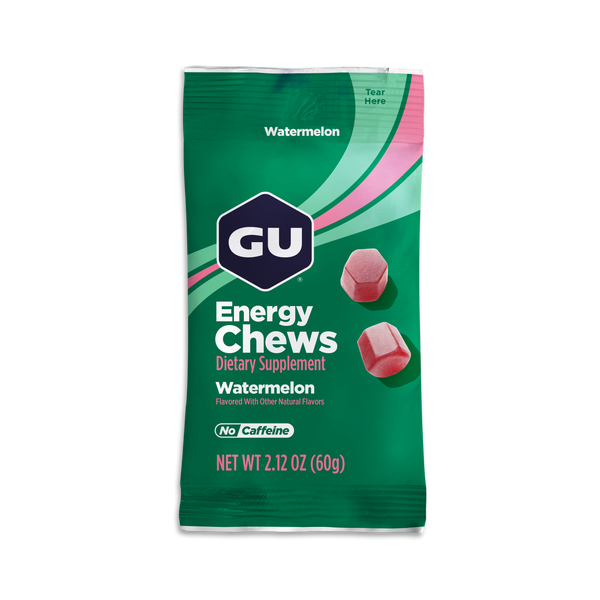
GU Energy Chews are built for exactly this kind of effort: portable, chewable carbohydrate and electrolyte support for whatever the activity is. This guide covers what's in a chew, how duration changes what you need, and how much to take for a gym session, a cycling class, or a hike.
Quick Reference: Chews by Effort Length
|
Effort Length |
Chews |
Caffeine Timing |
Add-Ons |
|
0-90 minutes |
One serving pre-effort, water alongside |
Optional, single dose if needed |
None required |
|
90 min-2 hours |
One serving every 20-30 minutes |
First caffeinated serving here if using |
Water throughout |
|
2-3 hours |
Chews as base, alternate with a gel during surges |
Space caffeinated servings 4-6 hours apart |
Hydration Tabs for electrolytes |
|
3+ hours |
Chews as base, gels for fast top-ups, Roctane late |
Track total caffeine across all products used |
Athlete's Note: Chews and Original Energy Gel share the same core nutrient profile, broken down in the next section. The difference is format, not function.
What's Actually in a GU Energy Chew
Three ingredients do the work in every 90-calorie serving of GU Energy Chews:
- Carbohydrates, 22g (maltodextrin + fructose)
- With a single carbohydrate source, absorption caps out and intake can't keep pace with what the body is burning through.
- The dual-source blend raises that cap, letting an athlete keep taking in carbohydrate at closer to the rate a long effort actually demands (Arjomandkhah et al., 2025).
- Sodium, 40mg
- Sodium is the primary electrolyte lost through sweat, and replacing it helps the body hold onto the fluid it takes in rather than losing that fluid straight back out through urine (Armstrong, 2021).
- Pairing sodium with fluid intake is what keeps hydration effective rather than just adding volume.
- BCAA blend, 400mg (L-Leucine, L-Valine, L-Isoleucine)
- These three amino acids supply building blocks the body uses for muscle protein synthesis during and after exercise, and BCAA intake has been shown to reduce markers of muscle protein breakdown (Kaspy et al., 2024).
- They may also reduce muscle soreness following exercise-induced muscle damage, though the size of that effect varies with dose and study quality (Salem et al., 2024).
Why Duration Over 90 Minutes Changes What You Need
Once glycogen stores start to draw down, carbohydrate intake shifts from optional to functional. This applies to a heavy lift session, a long hike, or a cycling class the same way it applies to a run.
Duration and total training volume, not the type of activity, are what determine when carbohydrate becomes necessary, and that holds for strength and mixed-modality training as much as it does for endurance sport.
In practice:
- A workout under 45 minutes rarely needs fueling mid-session.
- Once a session runs longer, or climbs past roughly 10 hard sets per muscle group, carbohydrate starts to make a measurable difference, whether that work is a lift, a ride, or a run (King et al., 2022; Henselmans et al., 2022).
Once a workout, of any kind, pushes past the 90-minute mark, shift from a single energized start to active refueling every 20 to 30 minutes.
How Many Chews You Need, by Scenario
The best energy chews for workouts are the ones matched to how long you're actually out there, not a single fixed serving size. Fueling breaks into effort tiers, and the same tiers apply whether the clock is measuring a run or a lift.
The Two-Hour Lift
A strength session that runs 90 minutes to two hours, particularly one with high total volume, calls for one serving roughly every 20 to 30 minutes, with water alongside each serving to help the body process the carbohydrate. See the full strength training fuel guide for a session-by-session plan.
The Spin-to-Strength Stack
A cycling class followed immediately by a strength block often crosses the 90-minute mark without feeling like a single long effort. Treat it as one continuous session for fueling purposes: start with a serving before the cycling portion, then repeat every 20 to 30 minutes through the strength work. More on fueling a ride start to finish: cycling fuel guide
The All-Afternoon Hike
A hike that extends past two to three hours moves into the higher-duration tier, where chews alone may not cover the full carbohydrate need. This is where stacking with other formats becomes relevant, covered in the next section. See the full hiking fuel guide for longer trail-day planning.
Stacking Chews With the Rest of Your Fuel Plan
Many athletes don't run one format for an entire effort. As distance and intensity shift, particularly past the two-hour mark, the effective approach is to sequence formats to match what the moment demands:
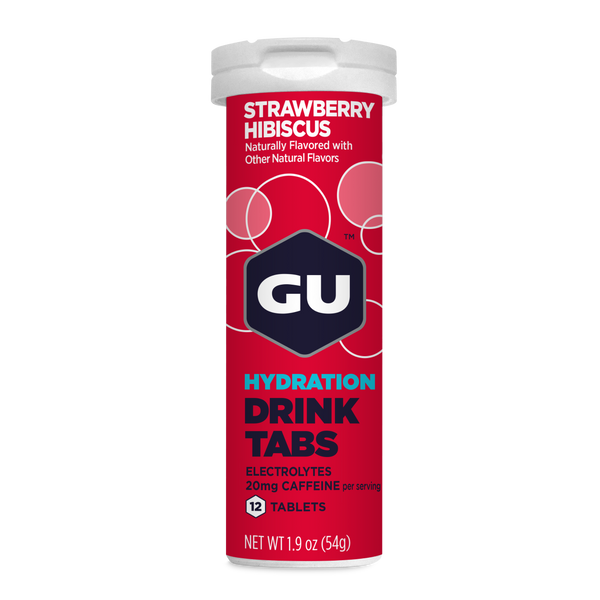
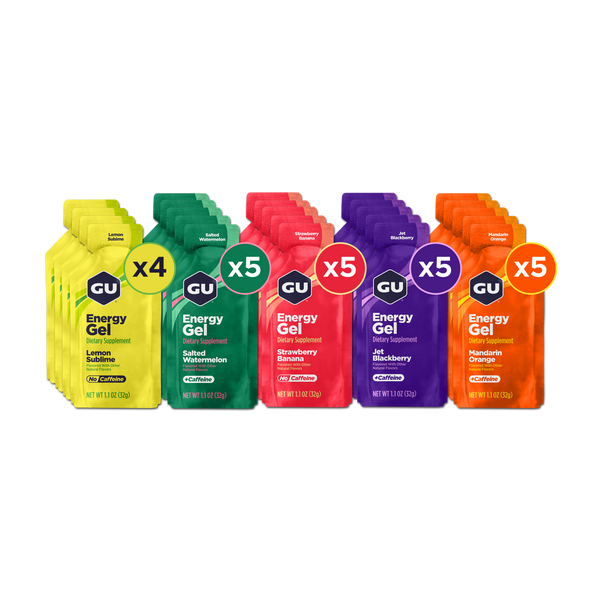
- 2 to 3 hours: Use chews as the base and alternate with an Energy Gel during surges or harder efforts. Add Hydration Tabs for electrolyte replacement.
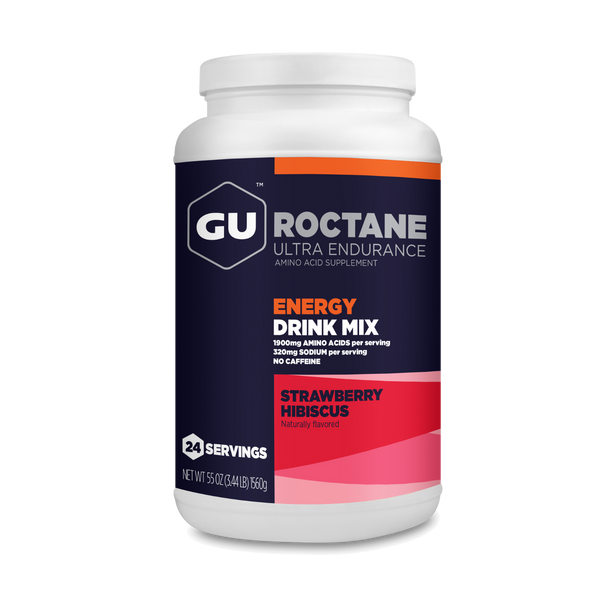
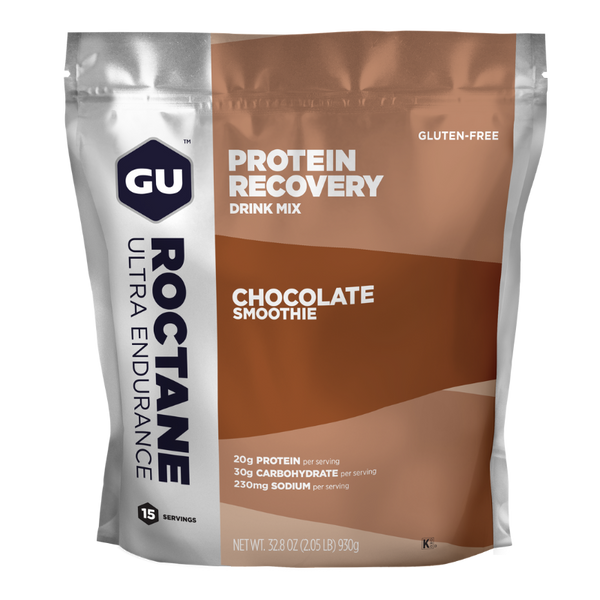
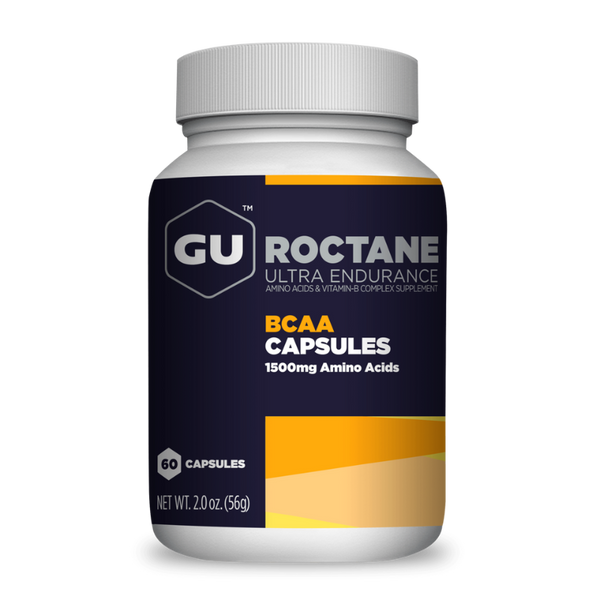
- 3+ hours: Chews stay the base while gels handle fast top-ups. Bring in Roctane products late, both for energy and to increase BCAA intake as fatigue accumulates.
There's no requirement to pick one format and stick with it for an entire session. The athletes who get it right aren't the ones who stick to one perfect product. They're the ones who sequenced their fuel to match what each stage of the effort really demanded.
Flavor and Caffeine
GU Energy Chews come in eight flavors.
- Caffeinated: Strawberry (20mg per serving)
- Caffeine-free: Fruit Punch, Rainbow Fruit Mix, Orange, Blueberry Pomegranate, Watermelon, Salted Lime, Lemonade
Caffeine's performance benefit is well established at specific doses.
The International Society of Sports Nutrition's position stand on caffeine found consistent evidence for improved aerobic endurance performance at doses of 3 to 6mg per kg of body weight, most commonly timed around 60 minutes before exercise (Guest et al., 2021).
A single strawberry Chew's 20mg of caffeine falls well under that full performance dose on its own, so caffeine timing across multiple servings, or pairing with a caffeinated gel, matters more than reaching for a single chew expecting a full caffeine effect.
Chews vs. Gels for Longer Sessions
|
Energy Chews |
Original Energy Gel |
|
|
Calories |
90 |
100 |
|
Carbohydrates |
22g (maltodextrin + fructose) |
21-23g (maltodextrin + fructose, varies by flavor) |
|
Sodium |
40mg |
60-125mg, varies by flavor |
|
BCAA blend |
400mg |
450mg |
|
Digestion speed |
Slightly slower, solid form |
Faster, semi-liquid form |
|
Texture |
Chewable, gummy |
Gel, swallowed directly |
|
Best fit |
Sessions where chewing is easy to do mid-activity: lifting, hiking, cycling breaks |
Sessions where hands-free, fast intake matters most |
Chews and Original Gel deliver a comparable nutrient profile, with the gel carrying a somewhat higher sodium and BCAA dose depending on flavor. The meaningful functional difference is digestion speed and format.
Because chews are solid, they take slightly longer to digest, while a gel reaches the bloodstream faster.
Frequently Asked Questions
Q: What are the best energy chews for workouts?
A: The best energy chews for workouts over 90 minutes combine dual-source carbohydrate (maltodextrin and fructose) with sodium and a BCAA blend, taken roughly every 20 to 30 minutes once effort passes the 90-minute mark. Format matters too: chews suit steady, sustained effort better than gels do, since they release carbohydrate more gradually.
Q: Do GU Energy Chews have caffeine?
A: Strawberry is the only caffeinated flavor, at 20mg per serving. All other flavors are caffeine-free, so you can choose based on effort length, time of day, and how much caffeine you've already had from other sources.
Q: Do energy chews help with hydration?
A: GU Energy Chews are formulated primarily for carbohydrate delivery, not hydration. For fluid and electrolyte replacement on longer efforts, pair chews with Hydration Tabs rather than relying on chews alone.
Q: Are energy chews good for athletes?
A: Energy chews deliver carbohydrate, sodium, and a BCAA blend in a portable, chewable format that works across running, cycling, lifting, and hiking alike. The nutrient profile is built for sustained effort, not any one sport specifically, which is why the same serving guidance applies whether the activity is a long ride or a long lift.
References
- Arjomandkhah, N.C., King, A.J., Griffiths, A., King, R.F.G.J., Morrison, D.J., Preston, T., and O'Hara, J.P. Glucose and fructose contributions to exogenous carbohydrate oxidation and performance at moderate altitude. Journal of Physiology, 2025. PMID: 42166208. https://pubmed.ncbi.nlm.nih.gov/42166208/
- Armstrong, L.E. Rehydration during Endurance Exercise: Challenges, Research, Options, Methods. Nutrients, 2021. 13(3): p. 887. https://doi.org/10.3390/nu13030887
- Guest, N.S., VanDusseldorp, T.A., Nelson, M.T., Grgic, J., Schoenfeld, B.J., Jenkins, N.D.M., Arent, S.M., Antonio, J., Stout, J.R., Trexler, E.T., Smith-Ryan, A.E., Goldstein, E.R., Kalman, D.S., and Campbell, B.I. International Society of Sports Nutrition position stand: caffeine and exercise performance. Journal of the International Society of Sports Nutrition, 2021. 18(1): p. 1. PMID: 33388079. https://pubmed.ncbi.nlm.nih.gov/33388079/
- Henselmans, M., Bjørnsen, T., Hedderman, R., and Vårvik, F.T. The Effect of Carbohydrate Intake on Strength and Resistance Training Performance: A Systematic Review. Nutrients, 2022. 14(4): p. 856. https://pubmed.ncbi.nlm.nih.gov/35215506/
- Kaspy, M.S., Hannaian, S.J., Bell, Z.W., and Churchward-Venne, T.A. The effects of branched-chain amino acids on muscle protein synthesis, muscle protein breakdown and associated molecular signalling responses in humans: an update. Nutrition Research Reviews, 2024. 37(2): p. 273-286. PMID: 37681443. https://pubmed.ncbi.nlm.nih.gov/37681443/
- King, A., Helms, E., Zinn, C., and Jukic, I. The Ergogenic Effects of Acute Carbohydrate Feeding on Resistance Exercise Performance: A Systematic Review and Meta-analysis. Sports Medicine, 2022. 52(11): p. 2691-2712. https://doi.org/10.1007/s40279-022-01716-w
- McGee, S.L. and Hargreaves, M. Exercise performance and health: Role of GLUT4. Free Radical Biology and Medicine, 2024. PMID: 39243828. https://pubmed.ncbi.nlm.nih.gov/39243828/
- Salem, A., Ben Maaoui, K., Jahrami, H., AlMarzooqi, M.A., Boukhris, O., Messai, B., Clark, C.C.T., Glenn, J.M., Ghazzaoui, H.A., Bragazzi, N.L., Ammar, A., Trabelsi, K., and Chtourou, H. Attenuating Muscle Damage Biomarkers and Muscle Soreness After an Exercise-Induced Muscle Damage with Branched-Chain Amino Acid (BCAA) Supplementation: A Systematic Review and Meta-analysis with Meta-regression. Sports Medicine - Open, 2024. https://pmc.ncbi.nlm.nih.gov/articles/PMC11021390/